
AI-Powered Digital Marketing in 2026: What Every Business Needs to Know
AI Isn't Replacing Marketers—It's Redefining Marketing
Artificial Intelligence (AI) is no longer a futuristic concept—it’s the foundation of modern digital marketing. In 2026, businesses that embrace AI are delivering more personalized customer experiences, optimizing campaigns faster, and making data-driven decisions with greater confidence.
The biggest shift isn’t that AI can create content or automate tasks. It’s that AI enables marketers to spend less time on repetitive work and more time on strategy, creativity, and building meaningful customer relationships.
If your business is still treating AI as an optional tool, you’re already competing against companies that use it every day to improve customer engagement, reduce marketing costs, and increase revenue.
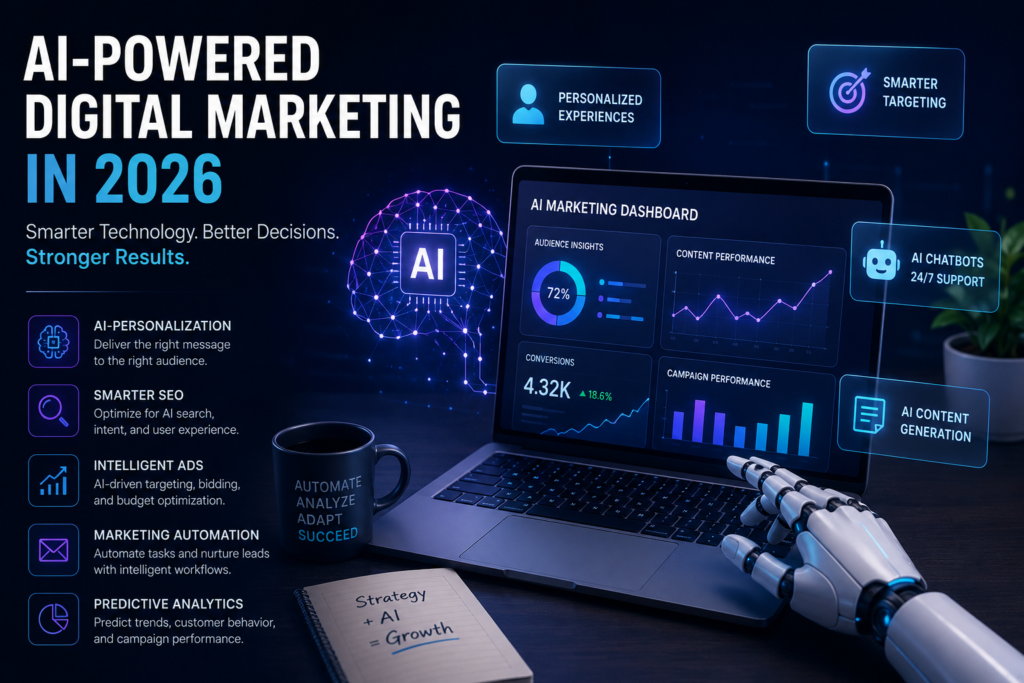
Why AI Matters More Than Ever in 2026
Digital marketing has become more competitive than ever. Consumers interact with brands across search engines, social media, email, messaging apps, and AI-powered search assistants. Expectations for personalized, relevant experiences continue to rise.
AI helps businesses meet these expectations by:
- Automating repetitive marketing tasks
- Understanding customer behavior in real time
- Creating personalized experiences at scale
- Improving advertising performance
- Predicting future customer actions
- Accelerating content production while maintaining quality
Businesses that combine AI with human expertise are gaining a measurable competitive advantage.
How AI Is Transforming Every Area of Digital Marketing
1. Smarter Content Creation
AI assists marketers with:
- Blog research
- Content outlines
- SEO optimization
- Email campaigns
- Social media captions
- Product descriptions
- Video scripts
However, high-performing content still depends on human insight, industry expertise, and original perspectives. AI should enhance creativity—not replace it.
Best Practice:
Use AI for research and drafting, then refine every piece with real experience, examples, and expert analysis.
2. SEO for the Age of AI Search
Traditional SEO has evolved.
Search engines increasingly prioritize content that demonstrates genuine expertise and satisfies user intent. AI-generated summaries and conversational search experiences are changing how people discover information.
Successful SEO in 2026 focuses on:
- Helpful, original content
- Topical authority
- Clear website structure
- Strong user experience
- Demonstrated expertise
- Trustworthy sources and accurate information
Businesses should optimize not only for search engines but also for AI-powered assistants that synthesize information for users.
3. Hyper-Personalized Customer Experiences
AI enables businesses to tailor marketing based on:
- Browsing behavior
- Purchase history
- Geographic location
- Customer interests
- Device usage
- Engagement patterns
Examples include:
- Personalized product recommendations
- Dynamic email content
- Customized landing pages
- Intelligent chatbots
- Predictive offers
Personalization increases customer satisfaction while improving conversion rates.
4. Smarter Paid Advertising
AI has become an essential component of paid advertising platforms.
It helps marketers:
- Optimize bids automatically
- Identify high-value audiences
- Allocate budgets efficiently
- Generate multiple ad variations
- Improve campaign performance
Rather than manually adjusting campaigns every day, marketers can focus on strategy while AI handles ongoing optimization.
5. Predictive Analytics
Modern AI tools analyze historical and real-time data to predict future outcomes.
Businesses can anticipate:
- Customer churn
- Sales opportunities
- Seasonal demand
- Marketing ROI
- Product preferences
Predictive insights allow businesses to make proactive decisions instead of reacting after opportunities are missed.
6. Marketing Automation at Scale
Automation has evolved beyond scheduled emails.
AI-powered workflows now manage:
- Lead nurturing
- Customer onboarding
- Cart abandonment recovery
- Customer support
- Follow-up sequences
- Audience segmentation
This improves efficiency while maintaining a personalized customer experience.
The Human Advantage Still Matters
Despite rapid advancements, AI cannot replace the qualities that define exceptional marketing:
- Creativity
- Strategic thinking
- Emotional intelligence
- Brand storytelling
- Ethical judgment
- Industry experience
Successful marketing in 2026 combines AI efficiency with human expertise.
Businesses that rely solely on automated content risk publishing generic, inaccurate, or untrustworthy information.
Common Mistakes Businesses Make with AI
Many organizations adopt AI without a clear strategy.
Avoid these common mistakes:
- Publishing AI-generated content without fact-checking
- Ignoring brand voice and messaging consistency
- Using AI without understanding customer needs
- Neglecting data privacy and security
- Prioritizing quantity over quality
AI is a powerful assistant—not a substitute for thoughtful marketing.
Building Trust in an AI-Driven Marketing Strategy
Trust has become one of the most valuable assets in digital marketing.
Businesses should:
- Verify all AI-generated information
- Cite credible data when appropriate
- Share real experiences and case studies
- Maintain transparent privacy practices
- Continuously monitor campaign performance
- Keep human oversight in every customer-facing interaction
Customers are more likely to engage with brands that demonstrate authenticity and accountability.
Practical Steps to Start Using AI Today
Whether you’re a startup or an established business, you can begin integrating AI into your marketing by:
- Auditing your current marketing workflow.
- Identifying repetitive tasks suitable for automation.
- Using AI for research and first drafts—not final publishing.
- Strengthening your SEO with high-quality, experience-driven content.
- Tracking campaign performance and refining strategies based on data.
- Investing in ongoing learning as AI technologies continue to evolve.
Incremental adoption often delivers better long-term results than attempting a complete transformation overnight.
Final Thoughts
AI-powered digital marketing in 2026 is about more than automation—it’s about making smarter decisions, delivering better customer experiences, and creating sustainable business growth.
Organizations that combine AI tools with human creativity, strategic thinking, and a commitment to quality will be best positioned to succeed in an increasingly competitive digital landscape.
The future belongs to marketers who embrace innovation without compromising authenticity. AI can accelerate your efforts, but trust, expertise, and genuine value remain the foundations of lasting success.