
The Complete Digital Marketing Strategy for Small Businesses in 2026
Small Businesses Have More Opportunities Than Ever—If They Have the Right Strategy
Running a small business in 2026 is both exciting and challenging. Customers have more choices, competition is stronger, and digital marketing is evolving faster than ever. Artificial intelligence, AI-powered search, social commerce, privacy-focused marketing, and changing consumer behavior have completely transformed how businesses attract and retain customers.
The good news?
Small businesses no longer need massive marketing budgets to compete with larger brands. With the right digital marketing strategy, even a local business or startup can build brand awareness, generate qualified leads, and achieve sustainable growth.
The key isn’t being everywhere—it’s being visible where your ideal customers are searching, engaging, and making purchasing decisions.
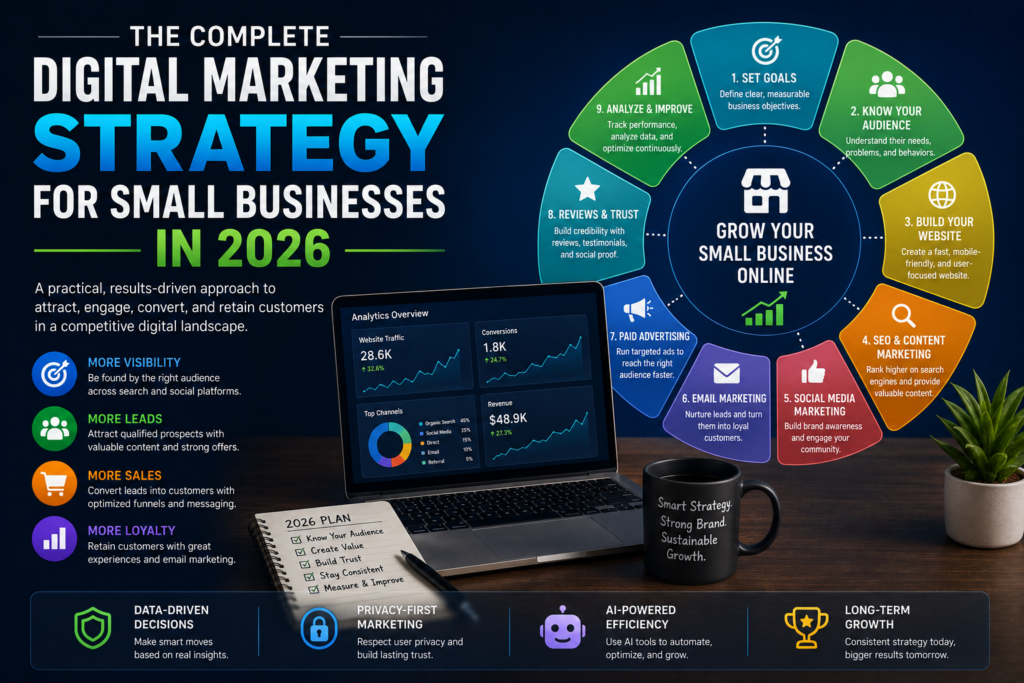
Small Businesses Have More Opportunities Than Ever—If They Have the Right Strategy
Running a small business in 2026 is both exciting and challenging. Customers have more choices, competition is stronger, and digital marketing is evolving faster than ever. Artificial intelligence, AI-powered search, social commerce, privacy-focused marketing, and changing consumer behavior have completely transformed how businesses attract and retain customers.
The good news?
Small businesses no longer need massive marketing budgets to compete with larger brands. With the right digital marketing strategy, even a local business or startup can build brand awareness, generate qualified leads, and achieve sustainable growth.
The key isn’t being everywhere—it’s being visible where your ideal customers are searching, engaging, and making purchasing decisions.
Why Every Small Business Needs a Digital Marketing Strategy
Many small businesses still rely on random social media posts, occasional advertisements, or word-of-mouth referrals.
While these tactics may generate some results, they rarely create consistent business growth.
A structured digital marketing strategy helps you:
- Increase online visibility
- Build trust with potential customers
- Generate high-quality leads
- Improve customer retention
- Maximize your marketing budget
- Measure performance and improve over time
A clear strategy ensures every marketing effort supports your business goals.
Step 1: Define Your Business Goals
Before choosing marketing channels or tools, identify what success looks like for your business.
Your goals might include:
- Increasing website traffic
- Generating qualified leads
- Growing online sales
- Building brand awareness
- Improving customer retention
- Expanding into new markets
Set SMART goals that are Specific, Measurable, Achievable, Relevant, and Time-bound.
Example:
“Increase qualified leads by 30% within six months through SEO and content marketing.”
Step 2: Understand Your Ideal Customer
Effective marketing starts with understanding your audience.
Ask questions such as:
- Who are they?
- What problems do they need solved?
- Where do they spend time online?
- What influences their purchasing decisions?
- What questions do they ask before buying?
Create customer personas based on real research rather than assumptions.
The better you understand your audience, the more relevant your marketing becomes.
Step 3: Build a Professional Website
Your website remains your digital headquarters.
It should:
- Load quickly
- Be mobile-friendly
- Use HTTPS for security
- Clearly explain your products or services
- Include strong calls to action
- Display customer testimonials
- Make contact information easy to find
A well-designed website builds credibility and supports every other marketing channel.
Step 4: Invest in SEO
Search Engine Optimization continues to be one of the most cost-effective long-term marketing investments.
In 2026, SEO focuses on:
- Helpful content
- User intent
- Technical performance
- AI search optimization
- Local SEO
- Topical authority
- High-quality backlinks
Rather than chasing rankings alone, create content that genuinely answers customer questions and demonstrates expertise.
Step 5: Create Valuable Content
Content marketing helps businesses attract customers before they are ready to buy.
Publish content such as:
- Blog articles
- Case studies
- How-to guides
- Industry insights
- Customer success stories
- FAQs
- Videos
- Infographics
Educational content builds trust, supports SEO, and positions your business as an industry expert.
Step 6: Build a Strong Social Media Presence
Social media is no longer just about visibility—it is a platform for customer engagement, education, and sales.
Focus on the platforms your audience uses most.
Share:
- Educational posts
- Short-form videos
- Customer testimonials
- Behind-the-scenes content
- Product demonstrations
- Industry news
Consistency and meaningful interaction matter more than posting frequently without purpose.
Step 7: Grow Your Email List
Email marketing remains one of the highest-performing digital marketing channels.
Build your list through:
- Newsletter signups
- Free resources
- Exclusive offers
- Event registrations
- Downloadable guides
Segment subscribers based on interests and send personalized content that provides genuine value.
Unlike social media algorithms, your email list is an asset you own.
Step 8: Use AI to Work Smarter
Artificial Intelligence is transforming digital marketing by improving efficiency and decision-making.
AI can help with:
- Keyword research
- Content planning
- Email personalization
- Audience segmentation
- Campaign optimization
- Marketing automation
- Performance reporting
However, AI should complement human expertise—not replace it.
Review all AI-generated content for accuracy, originality, and alignment with your brand voice.
Step 9: Leverage Local SEO
If your business serves a specific geographic area, local SEO is essential.
Optimize your:
- Google Business Profile
- Business directory listings
- Customer reviews
- Local keywords
- Location pages
Encourage satisfied customers to leave reviews and respond professionally to every review you receive.
Strong local visibility increases calls, visits, and inquiries.
Step 10: Build Trust Through Customer Reviews
Online reviews significantly influence purchasing decisions.
Encourage feedback after successful customer interactions.
Display testimonials on your website and social media.
Respond to reviews respectfully, whether they are positive or critical.
Transparency builds credibility and demonstrates your commitment to customer satisfaction.
Step 11: Measure Performance
Successful marketing relies on continuous improvement.
Track key performance indicators such as:
- Website traffic
- Organic search growth
- Conversion rate
- Cost per lead
- Customer acquisition cost
- Email engagement
- Social media reach
- Customer retention
- Revenue generated
Regular analysis helps you identify what works and where improvements are needed.
Common Digital Marketing Mistakes Small Businesses Should Avoid
Even the best businesses can waste time and budget by making avoidable mistakes.
Avoid:
- Marketing without a clear strategy
- Ignoring SEO
- Posting inconsistent content
- Buying followers or fake engagement
- Neglecting customer reviews
- Publishing unedited AI-generated content
- Failing to analyze campaign performance
- Trying to be active on every platform instead of focusing on the right ones
Sustainable growth comes from consistency, not shortcuts.
A Simple Digital Marketing Framework for 2026
A practical strategy for small businesses can follow this cycle:
Attract
Use SEO, blog content, social media, and local search to increase visibility.
Engage
Provide educational content, answer questions, and build relationships through email and social media.
Convert
Use clear calls to action, optimized landing pages, customer testimonials, and simple contact options to generate leads and sales.
Retain
Continue delivering value through follow-up emails, loyalty programs, personalized communication, and excellent customer service.
This continuous cycle supports long-term business growth.
Why E-E-A-T Is Essential for Small Businesses
Google increasingly rewards content that demonstrates:
- Experience: Share real examples, case studies, and lessons learned.
- Expertise: Publish accurate, in-depth, and helpful content.
- Authoritativeness: Build a reputation through consistent quality and industry knowledge.
- Trustworthiness: Be transparent, protect customer data, and deliver on your promises.
Businesses that prioritize trust are more likely to earn customer loyalty and stronger search visibility.
Final Thoughts
Digital marketing in 2026 is no longer about using every available platform or chasing the latest trend. It’s about creating a customer-focused strategy that combines valuable content, SEO, AI-powered tools, social media, email marketing, and data-driven decision-making.
Small businesses that invest in long-term relationships instead of short-term tactics will be better positioned to compete in an increasingly digital marketplace.
Start with clear goals, understand your audience, create content that solves real problems, and measure your results consistently.
The businesses that succeed in 2026 won’t necessarily have the biggest budgets—they’ll have the smartest strategies.
About the Author
I’m a digital marketing professional specializing in SEO, content marketing, AI-powered marketing strategies, social media management, and performance analytics. I help startups and small businesses build sustainable online growth through practical, data-driven marketing strategies that prioritize customer trust, measurable results, and long-term success.
If you’re looking to develop a customized digital marketing strategy for your business, I’d be happy to connect through my portfolio.