
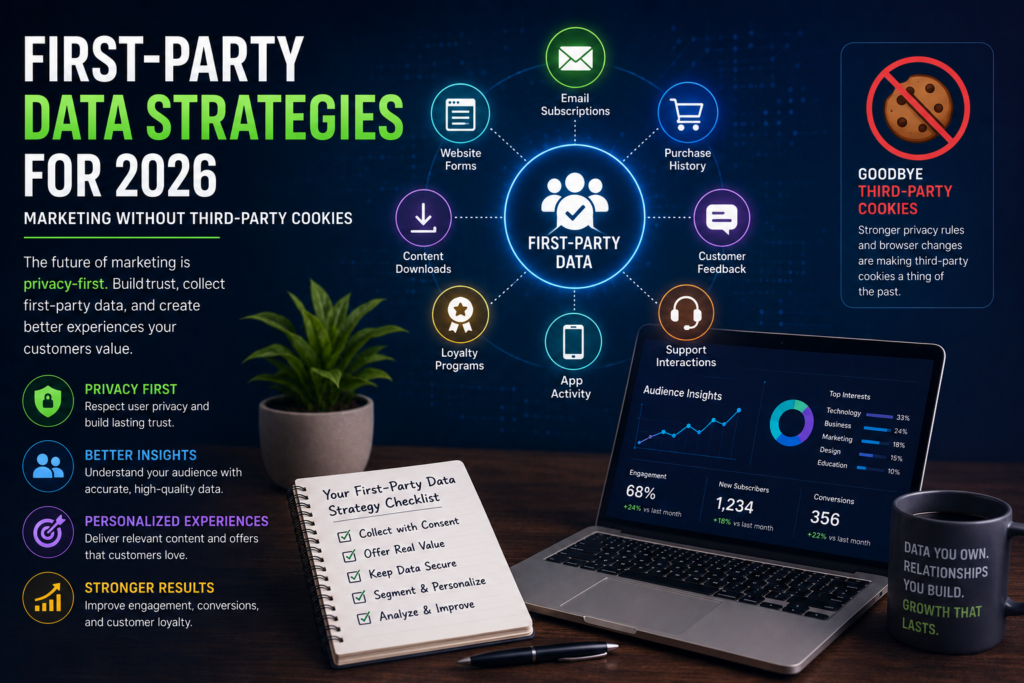
First-Party Data Strategies for 2026: Marketing Without Third-Party Cookies
The End of Third-Party Cookies Is Here—Are You Ready?
For years, digital marketers relied on third-party cookies to track user behavior, personalize advertisements, and measure campaign performance. But privacy regulations, changing consumer expectations, and browser restrictions have fundamentally changed the digital marketing landscape.
In 2026, businesses can no longer depend on third-party data to understand their customers.
Instead, the most successful brands are investing in first-party data—information collected directly from customers through trusted interactions.
This shift isn’t just about compliance. It’s an opportunity to build stronger customer relationships, deliver personalized experiences, and create sustainable marketing strategies based on trust rather than tracking.
What Is First-Party Data?
First-party data is information that your business collects directly from customers through your own digital channels.
Examples include:
- Website registrations
- Contact forms
- Email subscriptions
- Purchase history
- Customer feedback
- Survey responses
- Mobile app activity
- Loyalty program participation
- CRM records
- Customer support interactions
Unlike third-party data, first-party data is accurate, permission-based, and highly relevant because it comes directly from people who have chosen to interact with your business.
Why Third-Party Cookies Are Disappearing
The digital advertising ecosystem is changing rapidly.
Several factors have accelerated the decline of third-party cookies:
- Stronger privacy regulations
- Increased consumer awareness of data privacy
- Browser restrictions on tracking technologies
- Demand for transparent data collection
- Growing emphasis on user consent
As a result, marketers must adopt privacy-first strategies that respect user preferences while maintaining effective customer engagement.
Why First-Party Data Matters More Than Ever
Businesses that invest in first-party data gain several competitive advantages.
They can:
- Better understand customer behavior
- Deliver personalized experiences
- Improve marketing performance
- Build long-term customer relationships
- Reduce dependence on advertising platforms
- Strengthen customer trust
Most importantly, first-party data belongs to your business, giving you greater control over your marketing strategy.
1. Create Valuable Reasons for Customers to Share Information
People are willing to share information when they receive meaningful value in return.
Offer incentives such as:
- Free downloadable resources
- Exclusive newsletters
- Educational webinars
- Discount codes
- Product updates
- Loyalty rewards
- Personalized recommendations
The key is transparency. Clearly explain what information you collect and how it benefits the customer.
2. Build an Effective Email Marketing Strategy
Email remains one of the most valuable first-party data channels.
Every subscriber represents a direct connection with your audience.
To grow your email list:
- Use simple signup forms
- Offer valuable lead magnets
- Segment subscribers by interests
- Send personalized content
- Respect unsubscribe requests
- Maintain consistent communication
Quality subscribers deliver greater long-term value than large, unengaged lists.
3. Improve Customer Data Collection Through Your Website
Your website is one of the richest sources of first-party data.
Optimize it by collecting insights through:
- Newsletter subscriptions
- Contact forms
- Live chat interactions
- Product inquiries
- Customer accounts
- Purchase history
- Downloadable resources
Always request only the information you genuinely need and make the purpose clear.
4. Use Customer Relationship Management (CRM) Systems
A CRM system helps businesses organize, analyze, and use customer information effectively.
A well-managed CRM enables you to:
- Track customer interactions
- Segment audiences
- Personalize communication
- Improve lead nurturing
- Measure customer lifetime value
- Strengthen customer retention
Accurate data supports smarter marketing decisions.
5. Deliver Personalized Experiences Responsibly
Modern customers expect personalization—but they also expect privacy.
Use first-party data to personalize:
- Email campaigns
- Product recommendations
- Website content
- Special offers
- Customer support
- Marketing automation
Personalization should always enhance the customer experience rather than feel intrusive.
6. Encourage Customer Feedback
Surveys and feedback forms provide valuable insights that analytics alone cannot capture.
Ask customers about:
- Product satisfaction
- Service quality
- User experience
- Future expectations
- Improvement suggestions
Listening to customers strengthens both marketing strategies and business relationships.
7. Strengthen Loyalty Programs
Loyalty programs encourage repeat purchases while generating valuable first-party data.
Successful programs reward customers through:
- Exclusive discounts
- Reward points
- Early product access
- Member-only content
- Birthday offers
- Referral incentives
Customers benefit from personalized rewards while businesses gain deeper insights into purchasing behavior.
Best Practices for Privacy-First Marketing
Collecting data responsibly is just as important as collecting it effectively.
Businesses should:
- Obtain clear customer consent
- Explain how information will be used
- Secure customer data
- Allow users to update preferences
- Honor unsubscribe requests promptly
- Comply with applicable privacy regulations
Trust is one of the most valuable assets in modern marketing.
Common Mistakes to Avoid
Many businesses struggle during the transition away from third-party cookies.
Avoid these common mistakes:
- Collecting unnecessary information
- Using unclear consent forms
- Ignoring customer privacy concerns
- Failing to organize collected data
- Sending generic marketing messages
- Relying solely on paid advertising platforms
A customer-first approach produces stronger long-term results.
How AI Enhances First-Party Data Marketing
Artificial Intelligence helps marketers make better use of first-party data without compromising privacy.
AI can assist with:
- Audience segmentation
- Predictive analytics
- Personalized recommendations
- Marketing automation
- Customer behavior analysis
- Campaign optimization
When combined with responsible data practices, AI improves both efficiency and customer experience.
Measuring Success in a Cookieless World
Marketing success in 2026 goes beyond tracking anonymous users.
Focus on meaningful metrics such as:
- Email subscriber growth
- Customer retention rate
- Repeat purchases
- Customer lifetime value
- Engagement rate
- Lead conversion rate
- Customer satisfaction
- Referral rate
These metrics provide a clearer picture of long-term business growth.
Practical Steps to Prepare Your Business
If you’re beginning your transition to first-party data, start with these actions:
- Audit your current data collection methods.
- Strengthen your email marketing strategy.
- Optimize website forms for better user experience.
- Implement or improve your CRM system.
- Develop valuable lead magnets.
- Prioritize transparency and customer consent.
- Regularly analyze and update your data strategy.
Small improvements made consistently can transform your marketing performance over time.
The Future of Digital Marketing Belongs to Trust
The decline of third-party cookies marks the beginning of a more transparent and customer-focused era.
Businesses that prioritize trust, respect privacy, and build direct relationships with their audiences will gain a lasting competitive advantage.
First-party data isn’t simply a replacement for third-party cookies—it’s the foundation of sustainable digital marketing.
Final Thoughts
Marketing without third-party cookies is not a limitation—it’s an opportunity to create stronger customer relationships based on transparency, value, and trust.
By investing in first-party data strategies, businesses can deliver more personalized experiences, improve campaign performance, and future-proof their marketing efforts in an increasingly privacy-conscious world.
The brands that thrive in 2026 will be those that earn customer trust rather than simply track customer behavior.
About the Author
I’m a digital marketing professional specializing in SEO, content marketing, AI-powered strategies, marketing automation, and data-driven growth. I help businesses build sustainable digital marketing systems by combining privacy-first practices with proven performance strategies.
If you’re looking to future-proof your marketing strategy or strengthen your customer data approach, feel free to connect with me through my portfolio.